
lunedì 28 settembre 2015
Sacco di Roma, bolle speculative, finanza
Il sacco di Roma non si ferma mai (e come potrebbe essere
altrimenti in una città di palazzinari?): A periodi di relativa stasi si
alternano periodi di furiosa attività edificatoria. Siamo rientrati in una di
queste da qualche anno, in conseguenza degli accordi di qualche anno fa del
governo Veltroni.Ogni fase però ha caratteristiche diverse. La fase delle
palazzine degli anni ’50, la fase dell’abusivismo, la fase dei centri
residenziali degli anni ottanta, e oggi la fase che definirei dei quartieri
fantasma. In tutta Roma, soprattutto nelle aree più periferiche, sorgono
vastissimi quartieri di casermoni gigantesch, generalmente piuttosto
distanziati (in modo da consumare più territorio) e vuoti. Non ho informazioni
dettagliate, ma sembra che questi palazzi non siano costruiti per essere
venduti, ma servano come garanzia per operazioni finanziare, forse per ottenere
mutui, forse come sottostante per l’emissione di derivati. A parte che si
tratta dell’ennesima distruzione di territorio (di cui ormai ne rimasto ben poco), vorrei ricordare che in
Spagna negli anni ’90 e all’inizio degli anni ‘2000 si ebbe un’enorme bolla
edilizia non molto dissimile da quella romana odierna, che, una volta
scoppiata, a gettato la Spagna
in una delle crisi economiche più gravi del già martoriato Sud Euriopa.


giovedì 24 settembre 2015
Soviet Union, von Hayek, pricing and Black-Scholes formula
After the collapse of the Soviet
Union , it became evidente the the higher productivity of free
market economy. But there was a time when this superiority was not at all
obvious. The Soviet Union was a super-power,
in the 30’s it had incredible rates of growth. and the industrial structure was
solid, although weaker than that of West. Criticisms of liberals were rather
unconvincing:, but one of them, the Austrian Von Hayek, put forward am idea
that probably caught the essence of the problems that much later would result
in the collapse of the system. He claimed that although in principle the
optimal allocation of resources can be achieved both in the free market and in
the socialist systems, as discussed in the early XXth century by Barone,, in a
socialist system it is impossible to set reliable prices yo goods and service,
and without reliable price sit is is impossible to decide where to allocate the
resources in an optimal way.
The criticism of von Hayek is often cited. But I was musing
about it when I was studying the Black-Scholes formula, which is about the
pricing of options, the main instrument of modern finance and therefore one of
the main sources of profit in the modern market.-The formula was developed precisely
to define prices of derivatives, which where very difficult to price, but it
relies heavily on a number of assumption that are not necessarily true and in
fact resulted completely wrong in the great financial crisis of 2008. It seems to
me that a consistent pricing system is impossible in the finance market, and
this leads to collapse not very differently to what happened in the Soviet Union .
More generally, I wonder if it is possible to price consistently
services. Derivatives are at least exchanged, and therefore the notion of price
has some meaning. In many services exchange in my opinion has no or little
meaning. You won’t exchange a good medical care with a bad medical care if you
have a disease, or a fly to London for a fly to Munich because the latter is cheaper, if you have to go to
London
mercoledì 23 settembre 2015
Guida galattica per autostoppisti, miss Italia e Hitler.
Nel romanzo "guida galattica per autostoppisti" di Douglas Adams, che non ho letto ma che è un libro di culto per i geeks, un popolo avanzatissimo domanda a un supercomputer qual è la riposta definitiva alle domande fondamentali della vita, e il computer risponde "42".
Un paio di considerazioni:
1) ha fatto scalpore la vincitrice di miss Italia che, richiesta in quale anno avrebbe voluto vivere, ha risposto nel 42. Quasi sicuramente è un'allusione al romanzo di Adams, estremamente ironica. Gli autori delle frasi messe in bocca alla bellona erano sicuri che il 99% non avrebbe colto il riferimento alla guida galattica, e ne sarebbero nate fiumi di polemiche come poi è avvenuto.
2) non posso non pensare che però ci sia una relazione tra 42 e 1942, l'hanno della battaglia di Stalingrado e l'anno in cui Hitler perde di fatto la guerra, e anche l'anno della battaglia delle Midway nel Pacifico (Hitler comincerà allora la pratica della terra bruciata e dei terribili stermini proprio perché rosicava di aver perso). C'è un sito molto grazioso su youtube, thoughty2, che con grande astuzia fa finta di aderire alle teorie cospirazioniste ma in realtà le smonta con metodo scientifico. Dopo ho scoperto che alludeva al romando di Adams, ma all'inizio non ho potuto fare a meno di pensare che si riferisse all'anno in cui il fascismo, che sembrava invincibile, viene fermato.
Un paio di considerazioni:
1) ha fatto scalpore la vincitrice di miss Italia che, richiesta in quale anno avrebbe voluto vivere, ha risposto nel 42. Quasi sicuramente è un'allusione al romanzo di Adams, estremamente ironica. Gli autori delle frasi messe in bocca alla bellona erano sicuri che il 99% non avrebbe colto il riferimento alla guida galattica, e ne sarebbero nate fiumi di polemiche come poi è avvenuto.
2) non posso non pensare che però ci sia una relazione tra 42 e 1942, l'hanno della battaglia di Stalingrado e l'anno in cui Hitler perde di fatto la guerra, e anche l'anno della battaglia delle Midway nel Pacifico (Hitler comincerà allora la pratica della terra bruciata e dei terribili stermini proprio perché rosicava di aver perso). C'è un sito molto grazioso su youtube, thoughty2, che con grande astuzia fa finta di aderire alle teorie cospirazioniste ma in realtà le smonta con metodo scientifico. Dopo ho scoperto che alludeva al romando di Adams, ma all'inizio non ho potuto fare a meno di pensare che si riferisse all'anno in cui il fascismo, che sembrava invincibile, viene fermato.
domenica 20 settembre 2015
Linguaggio, politica, nazione
Una nazione, cioè l'unità politica del mondo moderno, è fondata sul fatto che i suoi membri condividono la stessa lingua e quindi possono comunicare (anche se esistono casi di nazioni diverse che parlano la stessa lingua, p.es Austria Svizzera e Germania, ma questo vuol dire che è una condizione sufficiente ma non necessaria). Questo risultato in Francia e Gran Bretagna e Spagna è stato ottenuto imponendo con la forza una lingua parlata comune, mentre in Cina e nel mondo arabo (che sarebbe una nazione se non fosse per il veto delle potenze occidentali) questo è ottenuto con una lingua scritta comune e lingue parlate locali (gli americani fanno gran fatica a capirlo e tendono a dire che la puthonghua o mandarino non esiste).
In Italia l'unificazione linguistica (e quindi politica) è avvenuta di fatto solo negli anni '50, con la televisione, e la prima generazione che parla l'italiano come lingua madre e non come seconda lingua dopo il dialetto è quella nata intorno agli anni '70. Prima le unità politiche reali erano le città, i comuni medievali, le diocesi. Il leghismo in fondo è la reazione spaventata di alcune realtà molto provinciali a questa unificazione. L'unificazione è avvenuta contemporaneamente alla trasformazione da paese agricolo a paese industriale, quindi è difficile dire quale fenomeno prevalga, ma sospetto che l'unificazione linguistica abbia un momento ben maggiore.
Facevo queste riflessioni perché questo mi porta all'equazione politica = dialogo (lontanissima dall'idea di politica = guerra che ho tante volte citato soprattutto a proposito di Machiavelli), Se questo fosse vero, allora il vero problema dei Grillini è di prendere troppo alla lettera la celebre frase di McLuhan "il mezzo è il messaggio". La frase vuol dire che il mezzo modifica il modo di pensare (basta pensare alla stampa), ma il mezzo non basta assolutamente se non c'è un linguaggio. E quindi non basta internet, ci vuole un linguaggio. Che a dire il vero c'è, è il cospirazionismo, che ha tutta una sua sintassi e grammatica. Purtroppo il cospirazionismo è un ritorno al modo di pensare medievale, di villaggio isolato, in fondo adatto al villaggio globale, per ricitare mcLuhan.
In Italia l'unificazione linguistica (e quindi politica) è avvenuta di fatto solo negli anni '50, con la televisione, e la prima generazione che parla l'italiano come lingua madre e non come seconda lingua dopo il dialetto è quella nata intorno agli anni '70. Prima le unità politiche reali erano le città, i comuni medievali, le diocesi. Il leghismo in fondo è la reazione spaventata di alcune realtà molto provinciali a questa unificazione. L'unificazione è avvenuta contemporaneamente alla trasformazione da paese agricolo a paese industriale, quindi è difficile dire quale fenomeno prevalga, ma sospetto che l'unificazione linguistica abbia un momento ben maggiore.
Facevo queste riflessioni perché questo mi porta all'equazione politica = dialogo (lontanissima dall'idea di politica = guerra che ho tante volte citato soprattutto a proposito di Machiavelli), Se questo fosse vero, allora il vero problema dei Grillini è di prendere troppo alla lettera la celebre frase di McLuhan "il mezzo è il messaggio". La frase vuol dire che il mezzo modifica il modo di pensare (basta pensare alla stampa), ma il mezzo non basta assolutamente se non c'è un linguaggio. E quindi non basta internet, ci vuole un linguaggio. Che a dire il vero c'è, è il cospirazionismo, che ha tutta una sua sintassi e grammatica. Purtroppo il cospirazionismo è un ritorno al modo di pensare medievale, di villaggio isolato, in fondo adatto al villaggio globale, per ricitare mcLuhan.
domenica 13 settembre 2015
Revolutions
All countries, eventually, make the revolution. The first were the Germans, in the XV century, with Martin Luther, then the English, in the XVII, then the French and the Americans, and in the XIX century in South America. In the first half of XXth century it was the time of Russia and then China, and in the 70' s of Vietnam and Cambodia, and now is the time of the Arabs, It seems that there is only one exveption, Italy. According to Emmanuel Todd the age of revolution comes not as a consequence of the clash of classes, but when the number of literate people surpasses a certain threshold. The rule seems to be very consistent across all these revolution. In the case of Italy the basic literacy was reached in the XIX centuty, but maybe functional literacy is a much more recent conqeust, as shown by certain surveys that show a high rates of ltieracy but only very low rates of understanding compex textes. If it is so, maybe Italy will be no longer an exception in a short time. The collapse and the delegimitation of the ruling class may be a symptom.
martedì 8 settembre 2015
Breaking bad and the parody of the American dream
In the number of September of "Besti Movie", there is a story by Zerocalcare, the cartoonist, about am unlucky, unfashionable boy whom is bullied by a schoolmate. After having watched "Breaking Bad", he convinces himself to be able to fight for his rescue and to withstand the bully, but of course he is defeated, beaten, and the story ends with the poor boy teased by Zerocalcare and his friend who say that in America everybody has an opportuinty, but not in Italy. Breaking Bad is often misunderstood in Italy as a perfect although a bit amorale nincarnation of the American dream, but of course it is exactly the opposite. The morale of the TV story is that you need to become a drug dealer in order to pay for your medical care, since in America there is not a public health service, and thus it is a pardoy of the myth of the Lan of Opputrunity. I is not casuale that the serie begun in 2008, when Obama was elected.
I suppose that the irony is well understood in the USA, but this is not the case in Europe. As a magtter of fact, after the era of Reagan the United Staed have become one of the nations with less social mobility, much less than in Europe, but the idea of the American dream is so entrenched in the mind of Italians that they still believe in it. Of course, much of the owrk of the entertainment is to sell the American Dream to the world, and Italians are particularly sensitive to entertainment,.

I suppose that the irony is well understood in the USA, but this is not the case in Europe. As a magtter of fact, after the era of Reagan the United Staed have become one of the nations with less social mobility, much less than in Europe, but the idea of the American dream is so entrenched in the mind of Italians that they still believe in it. Of course, much of the owrk of the entertainment is to sell the American Dream to the world, and Italians are particularly sensitive to entertainment,.
From Bauhaus to modern house
I am reading Tom Wolfe's "from Bauhaus to our house", which describes the rise of modern archtiecture, in particular in the Uniited Staes. In the first chapter he describes the adventure of Bauhaus, whith his aim of starting again from zero. A funny book, very well written, but I'am afraid that it misses entirely the point. The poitn was not Bauhaus against Art Nouveau, but Bauhaus agaisnt the eclectism and the neogothic. Art Nouveau was and avant-garde, but the style of XIX century was for instance that of the rail station of Milan, which is a false. The revolt was not against bourgeoisie (although after the Russian Revolution a reference to socialism was obvious), but against hypochrysy, and the pure forms of modern architecture were a revolt against untruth.
domenica 6 settembre 2015
L'invidia del certo medio, il fascismo, i proletari

Il sottotitolo del murale di Zerocalcare (ci manca tutto non ci serve niente) riassume in una frase quello che era (ed è) lo spirito dei proletari (non volere niente) e che ne rappresentava la grandezza in contrapposizione con l'avidità dei borghesi e l'arroganza degli aristocratici.
Purtroppo con l'espandersi del ceto medio, si è creata una moltitudine di persona che (sostanzialmente) non ha niente, ma che invece di accontentarsi di quello che è, rosica moltissimo della sua povertà. Con il ché l'accusa più ricorrente a chi non rosica come loro è quella di essere "spocchioso" (vedi post precedente), tale è il senso di frustrazione e di invidia che la anima. Sarebbe abbastanza comico, se sentimenti dekl genere non fossero gli stessi che furono alla base del fascismo e dei pogrom contro gli ebrei..
domenica 30 agosto 2015
Battiato, danze sacrei di Gourdjeff, Julius Evola.e dialettica della destra italiana
Questo articolo è piuttosto carino, non tanto perché spieghi il significato delle danze di Gourdjeff quanto epr la frase finale: "anche alla faccia di coloro che lo accusano da sempre di essere soltanto uno pseudo-avanguardista per interesse, snob, antipatico e spocchiosamente elitario o addirittura un finto intellettuale “che cita Guenon e dimentica Evola solo perché il primo s'è convertito all'Islam”.
Due consdierazioni:
Primo. Non si capisce come faccia ad avere tanta presa il frusto ritornello, ripreso anche dall'astuto Renzi, tipico dei berlsuconian-fascisti, che uno è spocchioso (o che guadagna tanto) quando qualcuno non la pensa come loro. Che poi è esattamente l'argomento dell'armata della santa fede "i giacobini sono ricchi che vogliono rubarvi tutto (tutto non si sa cosa, visto che i contadini a cui si rivolgevano non avevano assolutamente nulla) siamo noi preti a aristocratici che stiamo dalla parte vostra". E non mi è mai stato chiaro perché un argomento ai limiti del delirio (delirare significa allontanarsi dalla realtà) potesse avere tanta presa.
Secondo. Uno dei tanti aspetti importanti del lavoro di Battiato è quello di togliere la "tradizione" alla destra (e non dimentichiamo che Guénon non era certo di sinistra). Non è il solo (Steiner, Castaneda), ma mentre Steiner (per esempio) fa solo una ricerca spirituale, Battiato (che è politicissimo) trasforma la sapienza in strumento di critica (va detto che lo fanno anche alcuni anarchici).
Due consdierazioni:
Primo. Non si capisce come faccia ad avere tanta presa il frusto ritornello, ripreso anche dall'astuto Renzi, tipico dei berlsuconian-fascisti, che uno è spocchioso (o che guadagna tanto) quando qualcuno non la pensa come loro. Che poi è esattamente l'argomento dell'armata della santa fede "i giacobini sono ricchi che vogliono rubarvi tutto (tutto non si sa cosa, visto che i contadini a cui si rivolgevano non avevano assolutamente nulla) siamo noi preti a aristocratici che stiamo dalla parte vostra". E non mi è mai stato chiaro perché un argomento ai limiti del delirio (delirare significa allontanarsi dalla realtà) potesse avere tanta presa.
Secondo. Uno dei tanti aspetti importanti del lavoro di Battiato è quello di togliere la "tradizione" alla destra (e non dimentichiamo che Guénon non era certo di sinistra). Non è il solo (Steiner, Castaneda), ma mentre Steiner (per esempio) fa solo una ricerca spirituale, Battiato (che è politicissimo) trasforma la sapienza in strumento di critica (va detto che lo fanno anche alcuni anarchici).
Che poi detto tra noi, Julius Evola, a questi /che trollano) li avrebbe considerati dei piccolo borghesi (quali sono).
The World of Conquest
I read on the Economist that Robert Conquerst, a socialist but a fierce anti-communist, believed that Lenin was a maniac. Maybe, but Churchill was a schizophrenic and Mrs Thatcher was anaffective. Of course, opposite evils do not cancel each other, but it is quite typical of the supporters of the "free world" (the world of Conquest)., to say the truth, but to say only half the truth. And half truths are perhaps worse than half lies, since it is much more difficult to unmask half truhts than to falisfiy half lies (although reading journals consistes actually in completing the information).
sabato 29 agosto 2015
Crisi delle banche, dollaro, crisi dei BRIC
Dicevo che la strategia usata per uscire dalla crisi è stata essenzialmente prima di addossare le immense perdite delle banche americane e inglesi allo stato, quindi di far pagare queste perdite all'Europa, che ha un'economia molto meno finanziarizzata (e in fondo più solida) dei Paesi anglosassoni. Il trucco è stato di tenere un euro fortissimo e un dollaro debole, col risultato che sulle esportazioni europee gli europei pagavano una sorta di tributo agli USA.
Adesso (grazie anche alla diminuzione del prezzo del petrolio, voluta soprattutto per indebolire la Russia), l'economia americana è ripartita e il dollaro si è notevolmente rafforzato (grazie anche all'annuncio che la Federal Reserve aumenterà i tassi attualmente bassissimi). Questo però ha mandato in crisi drammatica i BRIC, in particolare il Brasile ma anche la Cina, la cui crisi è però in parte dovuta all'invecchiamento della popolazione.
Adesso (grazie anche alla diminuzione del prezzo del petrolio, voluta soprattutto per indebolire la Russia), l'economia americana è ripartita e il dollaro si è notevolmente rafforzato (grazie anche all'annuncio che la Federal Reserve aumenterà i tassi attualmente bassissimi). Questo però ha mandato in crisi drammatica i BRIC, in particolare il Brasile ma anche la Cina, la cui crisi è però in parte dovuta all'invecchiamento della popolazione.
giovedì 27 agosto 2015
E haplogroups of Y human chromosome, Illyrians, the early Neolithic in Europe and Albanian
I come back on the interesting topic of the relationships between Y human haplogroups and linguistic families. When I encountered the map of the distribution of the E-V68 haplogroup of Y human chromosome.
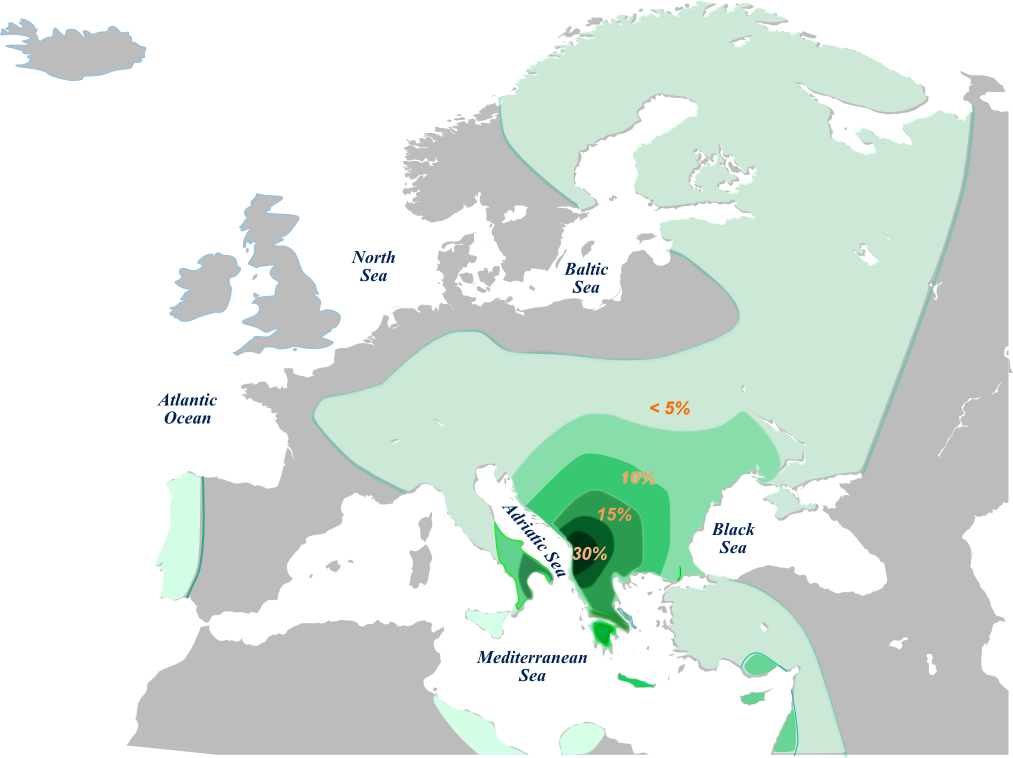
It matches strikingly the distribution of Illyrian languages. Actually, the distribution of Illyrians is not perfectly knownm but there is a peak of frequency in Albania and in Italy the highest frequencies are in Apulia, where lived the Messapi who spoke, according to the Ancient Authors, an Illyrian dialact.
The haplogroup is dated at about 10-15.000 years ago. There is a burial in Spain which is 7.000 years old where this haplogourp has been retrieved. From other sources the haplogroups is present also in Kurdistan, where, with all probability, lies the origin of agriculture, and therefore the haplogroups is related to Neolithic farmers invading Europe for the first time. If this hypothesi is true Illyrian, which is possibly an Indo-European language, should be about 7-8.000 years old, and thus may represent one of the earlies branches of the Indo-European lingustic family.
It msut be stressed that the Indoeuropean nature of Illyrian is not uncontroversial, since we have only a list of a few place and person names in Illyrian. Messapian is seemingly Indo-European, but Albanian - certainly a Indo-European language - which is spoken in more or less the same areas of the Illyrian,, has many strange feature (in particular many exclusive roots which seems to be non-Indoeuropean and a few grammatical endings of obscure origin) which could derive from Illyrian and which suggests a possible mixing of a Indoeuropean and a non-Indoeuropean language.
It matches strikingly the distribution of Illyrian languages. Actually, the distribution of Illyrians is not perfectly knownm but there is a peak of frequency in Albania and in Italy the highest frequencies are in Apulia, where lived the Messapi who spoke, according to the Ancient Authors, an Illyrian dialact.
The haplogroup is dated at about 10-15.000 years ago. There is a burial in Spain which is 7.000 years old where this haplogourp has been retrieved. From other sources the haplogroups is present also in Kurdistan, where, with all probability, lies the origin of agriculture, and therefore the haplogroups is related to Neolithic farmers invading Europe for the first time. If this hypothesi is true Illyrian, which is possibly an Indo-European language, should be about 7-8.000 years old, and thus may represent one of the earlies branches of the Indo-European lingustic family.
It msut be stressed that the Indoeuropean nature of Illyrian is not uncontroversial, since we have only a list of a few place and person names in Illyrian. Messapian is seemingly Indo-European, but Albanian - certainly a Indo-European language - which is spoken in more or less the same areas of the Illyrian,, has many strange feature (in particular many exclusive roots which seems to be non-Indoeuropean and a few grammatical endings of obscure origin) which could derive from Illyrian and which suggests a possible mixing of a Indoeuropean and a non-Indoeuropean language.
Political use of madness
Churchill, Bismarck and Cossiga all three were schizophrenic, and yet excellent politicans. But what I would like to point here is that their madness was not incidental in their career, but a fundamental tip to their success. At the beginning of World War II all reasonable people thought that Hitler and Germany were invincible, due to their extraordinary economic and military strenght. Only a mad could believe he Germany coul be beaten, and Britain resorted to a mad (Churchill) to win Hitler. Moreover, Hitler was obviously crazy, and in some way the history of World War II is the battle between two mads. Mads understand each other, whereas they are quite unpredictable to the sensed one.
Cossiga is a simialr story. Nobody dared to use the iron fist against the social movements and the armed struggle in the late '70 - in a context of Cold War and with a strong Communist Party. And what a sensible person would not dare to do, was done by a clever crazy.
A slightly different case is that of Margareth Thatcher. Mitterand said she had the eyes of Caligula: only an anaffective woman would have the gut to take the milk off from poor children in school, and the necessary character was found in Mrs Thatcher.
.jpg)
Cossiga is a simialr story. Nobody dared to use the iron fist against the social movements and the armed struggle in the late '70 - in a context of Cold War and with a strong Communist Party. And what a sensible person would not dare to do, was done by a clever crazy.
A slightly different case is that of Margareth Thatcher. Mitterand said she had the eyes of Caligula: only an anaffective woman would have the gut to take the milk off from poor children in school, and the necessary character was found in Mrs Thatcher.
lunedì 24 agosto 2015
Semeraro, the semitic etimologies and the J haplogroup of Y human chromosome
Semeraro claimed that alla languages are derived from Akkadian, or, more precisely stated (although this precision is not present in his writing), that many words of obscure etimology in Latin and Greek derive from Akkadian. In this more limited sense the etimologies proposed by Semeraro are convincing: apeiron from eperu, mud, europa from erepu, sunset, and so on. These etimologies did not gain a general consensus; anyhow, it could gain support from the distribution of Y haplogroups, in particular from the J haplogroup, which more or less matches the semitic languages, which is present with high frequenecy in Italy and Greece, suggesting a possible semitic substratum for these languages.
Renzi, il familismo amorale, e tutto cambi perché nulla cambi
Semplificando all'estremo, l'Italia è fondata su un sistema di raccomandazione e cordate, che però non ha potuto reggere la crisi globale del 2008. Renzi, che vuole presentarsi come paladino della modernizzazione, in realtà tenta di salvare questo sistema (tutto cambi perché nulla cambi, come al solito), aggredendo proprio quelle piccole sacche di persone indipendenti: la scuola, parte dei lavoratori, ecc., nella speranza che le risorse liberate bastino per sostenere il sistema.
Iscriviti a:
Post (Atom)