giovedì 24 dicembre 2015
Renzi, Baricco, e il gattopardismo dei ceti parassitari
Baricco pare che sostenga con forza il rinnovamento generazionale condotto da Renzi. Probabilmente non si è accorto che il renzismo altro non è che il gattopardesco "tutto cambi perché nulla cambi". Quando, con fatica, l'Italia fu unificata, il gattopardismo permise alle aristocrazie parassitarie che dominavano gli staterelli italiani di rimanere saldamente al potere. Oggi, che ci troviamo, nel bene e nel male, di fronte all'unificazione europea, i ceti parassitari che hanno governato l'Italia durante la prima e seconda repubblica cercano - e probabilmente riusciranno - di salvarsi di nuovo. Direi che il caso del decreto salvabanche è emblematico: la logica non è il fallimento creerebbe il collasso finanziario come nel '29, il criterio è "il fallimento butterebbe sul lastrico i furbetti del quartierino" (anche se un minimo di considerazioni di politica economica ci sono).

Autorità e potere
Il potere sveglia, l'autorità rincoglionisce. Questo è vero per chi lo subisce, ma soprattutto per chi lo eseercita.
mercoledì 25 novembre 2015
Islam, America, Russia and war
This war appears a war between Islam and the West, but is instead a war between America and Russia. Ant the fact that a war between the two main nuclear powers is impossible (hopefully at least), is the very reason why this war appears as a war between Islam and the Western Civiliaztion. I say America, but it would better to say between the group around McCain and the Russia. Mr Obama fiercely opposes the war.
domenica 22 novembre 2015
Evolution of the Indo-European languages, phentics, cladistics and the scientific method
This video about the evolution of Indo-European languages deserves to be listened. It criticizes a paper on Science, based on the method of clustering analysis, which tries to find the origin of IndoEuropean languages. Although the criticism it presents is 95% (I will come back on this later), I found it rather irritating. The reason of this irriation became clear to me at minute 45.50 where says that the research on science is close to the method of creationsim, since, instead of looking for the theory explaining the facts, it looks for the facts which support the theory. But this is not the method of creationsim, it is the hypothetica-deductive method of science. The method of creationists is "I believe in hypothesi A, let's find the facts that falsify the alternative hypothesis", and the latter is exactly the approach of the video.
Going into more detail, there are two approaches for the reconstruction of the tree of languages. The historical linguistic or traditional approaches compares in detaill single words of the languages, whereas the clustering method compares thousands of words at the same time. The two are obviously complementary, but the supporters of historical linguistics (like the authors of the video) never accepted the numerical methods. Some criticism is nonetheless founded. The two approaches exist also in taxonomy: the numerical method is called phenetic, since it looks for overall similarity, whereas the historical linguistic method is called cladistic, and in the latter method only shared similarities, not overall similarity are considered (Actually cladistic was invested in linguistic earlier than in taxonomy). At minute 24.30 the difference between the two approaches is discussed without the author being aware, obviously, of the existence of the same problems in taxonomy. In fact, if two languages (or two species) are compared on the base of overall similarity and not strictly on shared similarity, they appear more related than they are actually: the overall similarity of dolphins and fishes is large, but they are completely unrelated. Cladistic methods have never been applied in linguistics, to my knowledge, and it could be ftruiful to try.
Concerning the dating of the origin of languages the criticism of the video is that the dates of the tree contradict a few historical facts and that it does not consider movement of people like the latins conquering the Mediterranean. It is sensible, but useless, since the only way to estimated the origin of languages or cluster of languages for which there is no historical record is to assume constant rate of evolution. It is a pire aller, but nothing better exists.
Going into more detail, there are two approaches for the reconstruction of the tree of languages. The historical linguistic or traditional approaches compares in detaill single words of the languages, whereas the clustering method compares thousands of words at the same time. The two are obviously complementary, but the supporters of historical linguistics (like the authors of the video) never accepted the numerical methods. Some criticism is nonetheless founded. The two approaches exist also in taxonomy: the numerical method is called phenetic, since it looks for overall similarity, whereas the historical linguistic method is called cladistic, and in the latter method only shared similarities, not overall similarity are considered (Actually cladistic was invested in linguistic earlier than in taxonomy). At minute 24.30 the difference between the two approaches is discussed without the author being aware, obviously, of the existence of the same problems in taxonomy. In fact, if two languages (or two species) are compared on the base of overall similarity and not strictly on shared similarity, they appear more related than they are actually: the overall similarity of dolphins and fishes is large, but they are completely unrelated. Cladistic methods have never been applied in linguistics, to my knowledge, and it could be ftruiful to try.
Concerning the dating of the origin of languages the criticism of the video is that the dates of the tree contradict a few historical facts and that it does not consider movement of people like the latins conquering the Mediterranean. It is sensible, but useless, since the only way to estimated the origin of languages or cluster of languages for which there is no historical record is to assume constant rate of evolution. It is a pire aller, but nothing better exists.
sabato 21 novembre 2015
Costituzione, Corano, Renzi
Gramellini afferma che la Costituzione viene prima del Corano.
Forse occorrerebbe ricordare a Renzi che viene anche prima di Confindustria.
Forse occorrerebbe ricordare a Renzi che viene anche prima di Confindustria.
venerdì 6 novembre 2015
Muccino e Pasolini
Umberto Eco una volta disse che si può anche dire che Dante era un cattivo poeta, ma solo dopo 50 pagine di fitta analisi testuale. Il problema di Muccino che critica Pasolini perché non ha tecnica cinematografica non è tanto un mediocre che critica un gigante, quanto che non c'è argomentazione, come nelle chiacchere da bar. Tra l'altro, è abbastanza divertente che non si sia accorto che il carattere naif della tecnica cinematografica di Pasolini, assai evidente, rientra pienamente nello stile delle ricerca artistiche di avanguardia del secondo dopoguerra, che disprezzano la tecnica, da Duchamp al punk.
domenica 25 ottobre 2015
Chi mistica mastica
Fino a qualche anno fa era facile incontrare, negli ampi prati della periferia di Roma, aree incolte residuali tra le varie speculazioni e lottizzazioni, raccoglitrici di erbe spontanee, di solito contadine inurbate dalle conoscenze botaniche raffinatissime. Oggi questo personaggio - la "cicoriara" - è scomparso, ma proprio adesso che la sapienza contadina si è persa, sta dilagando la moda delle misticanze, queste insalate di erbe selvatiche gustosissime. Su facebook si trova per esempio un bel gruppo, a cui mi piace fare pubblicità, detto "erbe spontanee mangerecce". La coincidenza tra la scomparsa della tradizione e la riscoperta, di solito da persone di estrazione piccolo borghese, non è casuale, e fa parte della riscoperta del mondo contadino. Si tratta di qualcosa di abbastanza esteriore, ma speriamo che a qualcosa serva.
martedì 20 ottobre 2015
Unequality, economy and reward
Unequalities of income have reached an unprecedented level in the US, and, although this distortion is generally not questioned, a few critical voices are beginning to rise.
This video is an equilibrated discussion of the topic. It states that high unequalities are related to poor economical performance. In a nutshell, this is the second book of "The Capital", but I don't want to discuss the economical facet of the question. I would better address the ethical aspect of unequality. Supporters, claim that unequalities are healthy, since they prvide a reward for the skilled and the enterprising. This is maybe true, but provided that unequalities do not presresent an impassable barrier. When the unequalities are exaggerated, they become impassable, and we are no longer in an open society, but in a society of castes.
This video is an equilibrated discussion of the topic. It states that high unequalities are related to poor economical performance. In a nutshell, this is the second book of "The Capital", but I don't want to discuss the economical facet of the question. I would better address the ethical aspect of unequality. Supporters, claim that unequalities are healthy, since they prvide a reward for the skilled and the enterprising. This is maybe true, but provided that unequalities do not presresent an impassable barrier. When the unequalities are exaggerated, they become impassable, and we are no longer in an open society, but in a society of castes.
sabato 17 ottobre 2015
Cucina, avanguardie artistiche e estetizzazione della vita
In Italia, la centralità ,per non dire l'ossessione, del cibo non è certo nuova, però recente è la divizzazione degli chef, che sono diventate delle vere star. In parte è una moda, in parte è segno del raggiunto benessere (tanti che una volta si potevano permettere al massimo pane e mortadella oggi possono togliersi lo sfizio di un buon risotrante), però in parte è un fenomeno più profondo e generale, quello dell'estetizzazione della vita. Fare della vita un'opera d'arte, idea nata nel XIX secolo, è forse il motivo conduttore di tutta l'arte moderna, dagli arts and crafts al Bauhaus alla Soziale Plastik di Beuys. E il programma, sperimentato dalle avanguardie, ha avuto uno straordinario successo. Siamo circondati da oggetti materiali e immateriali (per esempio i video) informati dalla ricerche estetiche delle avanguardie. Il cinema per esempio è stato profondamente influenzato dal cubismo. E la cucina non fa eccezione.

venerdì 16 ottobre 2015
Transhumance
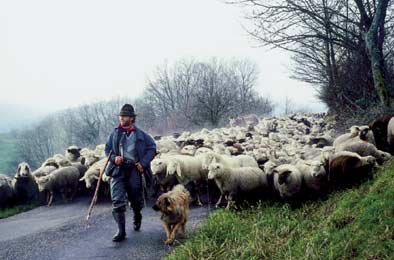
Transhumance was a common practice in the Apennines, consisting in the periodical movement of sheep, in summer from lowalnd to the pasture in the mountains, in autumn, after the rains, from the mountains to the greening lowland. Transhumance mirrored the natural migration of many ungulates, such as buffalos in the prairies of America or wildbeest in the savannas of Africa, and is therefore a very sustainable form of management. Today, unfortunately, it has almost disappeared.
domenica 11 ottobre 2015
Non essere cattivo
Discutevamo con un caro amico sul film postumo di Claudio Caligari "non essere cattivo", essenzialmente il remake vent'anni dopo del gran film "Amore tossico". L'uno trattava della vita di alcuni eroinomani, questo parla della vita di piccoli spacciatori al tempo della cocaina e delle metanfetamine. Il mio amico sosteneva che "non essere cattivo" mancava dell'epica potenza di "amore tossico", in quanto il relativo sentimentalismo dei personaggi poco si accorda con la durezza del mondo dei sottoproletari.

In realtà, penso che il problema sia ben altro: ""amore tossico" viene prima del 1989, "non essere cattivo" dopo. Nel 1983 tutti erano convinti che il proletariato avrebbe conquistato il mondo, nel 2015 non ci crede (quasi) più nessuno; i protagonisti di "amore tossico", quindi, a modo loro sono dei vincenti, mentre quelli di "non essere cattivo" sono assolutamente perdenti. Una punta di romanticismo è presente anche in "amore tossico", in quanto i proletari (e anche i sottoproletari) al fondo sono romanticissimi, anche se la durezza estrema della vita di borgata non lascia tante occasioni di esprimerlo, ma è il romanticismo dei forti; quello di "non essere cattivo" è il romanticismo dei deboli.
In realtà, penso che il problema sia ben altro: ""amore tossico" viene prima del 1989, "non essere cattivo" dopo. Nel 1983 tutti erano convinti che il proletariato avrebbe conquistato il mondo, nel 2015 non ci crede (quasi) più nessuno; i protagonisti di "amore tossico", quindi, a modo loro sono dei vincenti, mentre quelli di "non essere cattivo" sono assolutamente perdenti. Una punta di romanticismo è presente anche in "amore tossico", in quanto i proletari (e anche i sottoproletari) al fondo sono romanticissimi, anche se la durezza estrema della vita di borgata non lascia tante occasioni di esprimerlo, ma è il romanticismo dei forti; quello di "non essere cattivo" è il romanticismo dei deboli.
domenica 4 ottobre 2015
Politically correct
I was reading ana rticle by Slavoy Žizek which criticizes the political correct in American univiersitez. A part drom the canonical but useless refrence to psychanalisis, the Sloveniana uthors claims that life hurts. and that it is senseless to create a guarded haven in university campuses. I ponderd over this question, Of course nobody wants to anesthetize the experience of living, and it is fundamental to recognize that pain and pleasure are cloesely interconntected even in the sweetest of relationship (the reference to psychanalysis means simply this). But I incline for the reasons of polytacl correctness. Pain and prevarication are not the same: there is a pain which arises from effort and confrontation, and a pain which arises from prevarication; the former is rare, the latter is much too common, and Žizek does not acknowledge this fundamental difference. It is by mo neamns unsensible or anesthetizing to experimtn a world without prevarication at least inside the walls of the campus. Of course this comes at a cost, since literature reflects society and society is fiull of prevarication; I think for instance to the Merchant of Venice, which today is impossible to represent for his declared antisemithism, but which is nonethless a unique masterpiece; perhaps it should be read again as a document of a sentimetn that was very widesperad bfore World War II but today is impossible.
The problem in my opinion is not in the politically correct, but in the fact that this attempt is limited to the university campuses, and compeltely unattended outside.
The problem in my opinion is not in the politically correct, but in the fact that this attempt is limited to the university campuses, and compeltely unattended outside.
Poets and nations
Not conquerors, but poets create nations. For instance Dante, who invented the same concept of Italy. Or Elias Lonnrot, the Finnish poet who collected the kalevala, creating, from sparse and inconsitent old tales, a Finnish national epos.
Andreotti, Moro e i proverbi cinesi
La famosa abilità politica di Andreotti si riduceva in fondo al detto "siediti sulla riva del fiume e aspetta di veder passare il cadavere del tuo nemico", che però ha funzionato benissimo. Ad essere più specifici, il suo nemico era Moro.
China and 2008 crise
Ultimately, it was China who paid for the huge debt of America, and this the ultimate reason behind the recent crisis of BRICS. During the crise after 2008, it was the exasperate growth of China that prevented the collapse of the West, but this effort has exhuasted the capacities of Chinese economy.
Iscriviti a:
Commenti (Atom)