The humped-back relationships proposed by Grime relates diversity and productivity in ecosystems and postulates that with increasing productivity there is first an increase of diversity and than, after a peak, a decrease at very high productivities. This hypothesis is based on the observation of herbaceous vegetation in temperate areas. The paper by Adler - Productivity Is a Poor Predictor of Plant Species Richness (Science 333,, 2011) compares a number of grasslands mainly in America with a few in other continents. The paper doesn’t find a pattern at the scale of the plot – but this doesn’t falsifies Grimes’ hypothesis that is concerned with diversity across ecosystems – and finds a significant humped backed relationship but with low explanatory power (r² = 0.11). I inspected the picture of the picture and I was surprised: there are 40 points before the peak and 2 points after the peak of the diversity-productivity relationship. Of course the explanatory power is low – the setis strongly unbalanced! Please revise the basics of regression – I often read excited debates about models so complicated that you can say practically everything about them and I didn’t read anything about this very simple bias (possibly beacuase of my inadequacy). If you interpret correctly the curve, the study supports Grime’s hypothesis. I suspect that the editor of Science noticed this, but a paper supporting Grime’s hypothesis would not be cited as frequently as a paper rejecting it.
Please take note that I think that humped backed relationship is probably false, not because we need to be mechanistic as is said in the conclusions of the paper or because nature is more complicated than claimed by Grime – when you say that a thing is complicated it means that you don’t understand it – but because we know almost nothing about the relationship between diversity and productivity in forests, where productivity is much more difficult to sample. The relationship in forests is probably linear (but the highest productiviiesy are lower than the peak in herbaceous communities), but nobody can say. There are a few very productive forests, for instance locust tree populations.
sabato 11 maggio 2013

Philosophy of ecology
Ecology is a strange discipline. A few ecologists are familiar with the innumerable diversity of organisms and habitats, and propose generalization based on their observations. This is standard science, but oddly enough this method is fiercely opposed by the dominant school of ecology, that thinks that generalizations rooted in observations are “pattern based ecology” and that "explanatory mechanism" must be provided. This boring debate dates to the beginning of ecology, and has much to do with the fact that there are about 300,000 species of vascular plants, 23,000 vertebrates and 1,000,000 species of insects, a dozen or so of major biomes and an astounding number of different communities, and it takes long to get acquainted with this diversity, whereas many abandon direct observation of ecosystems after their degree and become much more familiar with books than with nature. There is also an obvious relationship with political spirit of the time – “pattern” ecology was probably dominant in the 70s when the left was dominant, but is a minority today with vociferous radical Republicans in America and conservative grovernemes all around European countries.
But background is just a fragment of the picture. There is a more profound phylosophical underlying contrast, revealed by the frequent use in debates of term “mechanistic”. The Law of Gravitation is not mechanistic, it is phenomenological (strange to an ecoogist but true); Newton didn’t provide a mechanism for the attraction among the bodies; he explained with the force of attraction among the bodies the patterns of motion of planets obsreved by Kepler. I bet that an ecologist would have criticized him, and it must be said that Newton was actually criticized for not providing a mechanism by a few – mainly by aristotelians. The contrast between the dominant and the minority schools of ecology is the fundamental contrast between aristotelians and platonics. Ecology is largely aristotelic, physics is largely platonic. Galileo was condemned not because he was copernican – the theory was admitted as possible by the chief of the Vatican astronomers, the jesuit Christophorus Clavius – but because in the book “Dialogue concerning the two chied systems of the World” he ridiculized the aristotelian Simplicius. There is a famous ecology blogger that is ostensibly similar to Simplicius to any ecologist that have read the (fantaastic) book of Galileo. A platonic sees the regularity of mathematics in the apparently messiness of phenomena – in phylosophical terms he believes in the reality of universals – whereas Aristotelians thinks that regularities do not exist – universals do not exist - and it is impossible to convince him of the opposite. But it is impossible to do science if you believe that mathematical regularities do not exist, and this is the reason why Galileo adopted a rather neoplatonic point of view - he says that the book of nature is written in mathematical language, a typical platonism – and attacked harshly the aristotelians (eventually succumbing) and why Aristoteles is still actual in the politics, in literature, and logic, but his physics and to a lesser extent biology are close to superstition.
But background is just a fragment of the picture. There is a more profound phylosophical underlying contrast, revealed by the frequent use in debates of term “mechanistic”. The Law of Gravitation is not mechanistic, it is phenomenological (strange to an ecoogist but true); Newton didn’t provide a mechanism for the attraction among the bodies; he explained with the force of attraction among the bodies the patterns of motion of planets obsreved by Kepler. I bet that an ecologist would have criticized him, and it must be said that Newton was actually criticized for not providing a mechanism by a few – mainly by aristotelians. The contrast between the dominant and the minority schools of ecology is the fundamental contrast between aristotelians and platonics. Ecology is largely aristotelic, physics is largely platonic. Galileo was condemned not because he was copernican – the theory was admitted as possible by the chief of the Vatican astronomers, the jesuit Christophorus Clavius – but because in the book “Dialogue concerning the two chied systems of the World” he ridiculized the aristotelian Simplicius. There is a famous ecology blogger that is ostensibly similar to Simplicius to any ecologist that have read the (fantaastic) book of Galileo. A platonic sees the regularity of mathematics in the apparently messiness of phenomena – in phylosophical terms he believes in the reality of universals – whereas Aristotelians thinks that regularities do not exist – universals do not exist - and it is impossible to convince him of the opposite. But it is impossible to do science if you believe that mathematical regularities do not exist, and this is the reason why Galileo adopted a rather neoplatonic point of view - he says that the book of nature is written in mathematical language, a typical platonism – and attacked harshly the aristotelians (eventually succumbing) and why Aristoteles is still actual in the politics, in literature, and logic, but his physics and to a lesser extent biology are close to superstition.
And yet science –as put forward by Galileo- of Aristoteles and Plato, of particular and universal. It would be nice if the two phylosophical attitudes could cooperate as happens in theorical and experimental physics, instead of purposelessly quarreling all time. This doesn’t happen because the overcoming of the depp but naive intuitive positions of Aristeoteles and Plato happens only if things are considered not statically – as invariably the ancient Greeks did – but dinamically. The synthesis of Galielo arose from the study of cynematic - the motion of bodies - and ecologists - while repeating endlessly the word "process" - rarely consider patterns in time - with a notable exception, the ecology of limnos, undoubtedly vecause such ecosystems are very simple but not real, not laboratory constructions.
martedì 7 maggio 2013
Masochismo
Riporto questo link a un commento di Aurelio Picca su Pasolini: http://www.ilgiornale.it/news/ora-basta-santificazioni-pasolini-resta-lupo.html. Nonostante il "Giornale" non sia certo la sede pià propensa verso i gay, sono sostanzialmente d'accordo con lui. E' ben noto che moltissimi gay muoiono uccisi dai loro amanti prezzolati o meno - il primo forse fu Giulio Cesare - e temo che a Pasolini sia successo questo. Per contro, il presunto masochismo non significa che "se la sia cercata" come sembra intendere Picca. Ci sono fior di masochisti - soprattutto etero - che muoiono anziani e serenamente. E tra l'altro non ne sono neanche sicuro - la morte di cui parla Picca è la croce cristiana, mentre quella di Salò è la pulsione di annientamentodel fascismo - tra l'altro resa come da nessun altro - e la metafora non è più disgustosa del suo oggetto.
lunedì 6 maggio 2013
Informatic Middle Age
Are we entering the informatic middle age? In 1971 Giorgio Vacca, a member of the Club of Rome and an engineer that involved in the first, pionieristic attempts at computer modeling of complex itnerrelationship when computer power was ridiculously small – published “The Forthcoming Middle Age”. In this book he says that the systems we have build and on which depend the life of people will become so complex that we will lose the ability to understand and manage them. I remember this old book when I browse the web, and I find a sort of new religion, intolerant exactly like the Christianity of IV-V century a.C., when I see that books or at least reading are disappearing, like at the fall of the Roman Empire, and even when I see that in many branches of science the rigorous logical-mathematical way of thinking that was developed by scientists like Euclid or Archimedes is replaced by simple, intuitite thinking based on computer modeling. And also the economic system seems to be in deep crisis; true, BRICS and many other developing countries are growing exponentially, yet this growth is driven by the difference of costs between developed and developing countries, and it is difficult that it will last more than 20-30 years.
Middle Age lasted 1000 years. The Reinessance was largely a rediscovery of the wisdom and techniques of the ancients, but this rediscovery gave new life to the undoubtedly innovative ideas of Christianity. For instance, the idea of equality was substantially alien to the Ancient, that could not put on the same plane an aristocrat, a plebeian, or a slave, and was introduced into the estern Civilization by Christianism, and yet it became a leading idea only in XVIII century, almost two thousaad years after the “Tale of the Mountain”. We are entering in an era of regression, must we await after 1000 years a Reinessance where the power of informatic turns from regressive to progressive?
Middle Age lasted 1000 years. The Reinessance was largely a rediscovery of the wisdom and techniques of the ancients, but this rediscovery gave new life to the undoubtedly innovative ideas of Christianity. For instance, the idea of equality was substantially alien to the Ancient, that could not put on the same plane an aristocrat, a plebeian, or a slave, and was introduced into the estern Civilization by Christianism, and yet it became a leading idea only in XVIII century, almost two thousaad years after the “Tale of the Mountain”. We are entering in an era of regression, must we await after 1000 years a Reinessance where the power of informatic turns from regressive to progressive?
History of art
Philippe Daverio, the art.., says that the traditional classification into periods dates to XIX century, when modern art was Raphael and contemporary art was Hayek, and that it has do be deeply rethinked. To my knowledge, he has not put down explicitly a new periodization, but, from sparse hints, it seems to be 1300-1700 (From van Eyck and Giotto to Poussin), 1800-about 1920 (from Ingres and David to Picasso, Kandinskij and the other historical vanguards), and 1920-today (from Duchamp onwards). If I don’t mistake the ideas of Daverio, it seems very sensible. The art of XX century, in fact, is very different before and after World War II, and Picasso and Hirst have probably very little in common.
This periodization of the history of art suggests a parallel segmentation of the history of Man. The end of the Midle Age is traditionally dated at the end of XV century, after the discovery of Americas by Columbus France Italy Italy and in part in the Flandres, and then spreads slowly to Europe , attaining a turning point with the rise of national states and the beginning of colonialism. And it ends in the XX century, with the rise of mass society – this is the surprising idea of Daverio. This pre-dated passage from modernity to post-modernity is related to the astounding rush of technological innovations, the expansion of the middle classes, World War I, the end of colonialism, and Russian Revolution.
Renzo Rubino

Renzo Rubino si presenta al concerto del 1° maggio (quest’anno con pochissimo sociale e diversi gay) con la maglietta della Gioconda – simbolo di androginia – e sparpaglia citazioni più o meno sottili qua e là. Giochini da studente, furbizia o vero talento? In ogni caso mi colpiscono le spalle larghissime da lottatore.
giovedì 2 maggio 2013
Fascism and rationalism
Fascist architecture and rationalist architecture look alike - they developed after all more or less in the same years. Anyway this resemblance is very superficial. In fact the architecture of Le Corbuser, Gropius, Mies van der Rohe is rational not or not only because it employs simple shapes with no decoration - parallelepipeds, cubes - but above all because it is functional - buildings should be "machines for living".

But fascists building are all but machines for living. They must impress and terrify, not be friendly. Huge staircaases, disproportionate volumes, a tendence to be higher than large. The style is the same - blocks, rows of frameless windows - but the meaning is opposite.


But fascists building are all but machines for living. They must impress and terrify, not be friendly. Huge staircaases, disproportionate volumes, a tendence to be higher than large. The style is the same - blocks, rows of frameless windows - but the meaning is opposite.
Of course, this doesn't mean that a few examples fo this architecture can be aesthetically pleasnt - for instance the "Palazzo della civiltà del lavoro" that is discussed in another post (http://castorphans.blogspot.it/2011/03/colosseo-quadrato.html) or the astounding "Casa del Fascio" in Como.
sabato 27 aprile 2013
Trotzkismo eterno
Se ci sono tre partiti, A B C, ognuno con circa un terzo dei seggi in parlamento, e il partito C detesta A e B ed esclude di allearsi con uno dei due, cosa succederà? Che A e B si alleeranno contro C. A quel punto, se non è in grado di far sciogliere il parlamento e andare a nuove elezioni, inutile che C frigni. Gli avversari vanno divisi, non fatti coalizzare, ma questo chiaramente presuppone che uno abbia veramente voglia di lottare e non di fare la bella statuina.
lunedì 22 aprile 2013
Napolitano bis
Grillo ha fatto finta di essere contro l"'inciucio", ma in realtà auspicava esattamente questo. Alle prossime elezioni ci sarà un'emorragia di voti dal PD a 5stelle. Le conseguenze per la vita delle persone (soprattutto dei suoi elettori) che deriveranno da questa intesa non gli interressano. Certo, è stato abilissimo, cosa che non si può dire del PD.

venerdì 22 marzo 2013
Fall
The authors of II century d.C., observing the rise of Christian religion, considered this faith as a "superstition", an were puzzled by the strange beliefs of christians, that challenged the humanism and the rationalism of their civilization. They were unaware that the Roman Empire would fall in a couple of centuries and that the absurd doctrine will become the indubitable religion for every European. I ponder over these old stories when I browse the web. There you find a large variety of things, but the dominant ones are political conspiracy, UFO, alternative economic theories, crop circles and so on. They appear as something absurd and illogical to the people that received a traditional education based on books (like me), but they seem to establish a coherent doctrine, based more on faith that on rational reasoning - not differently from the early Christina religion. In the Reinessance a synthesis between the humanism of the ancients and christian religion was realized . But this happened 1000 year after the collapse ot the ancient civilization.
venerdì 15 marzo 2013
Habemus papam
The episode of the dream of Pope Innoncence III - the subject of one of the frescos in the Church of the Saint in Assisi - is well known. The pope dreamed that the Lateran - the official residence of the Bishop of Rome - was ruining and that Francesco sustained it. The reference to this history is obvious in the choice of the name of the new pope, considering that the recent case sof pedophile priests that, remarkably, scandalised in particular the USA catholics. The scandal is probably not unrelated with the abidcation of Ratzinger.
 Many sites in the web underscore the ambiguous relationship of Bregoglio with the dictatorship in Argentina, other the conservatism with respect to gay rights; other emphasize the choice of poverty and the care for social problems. In other words, nobody knowns if he is progressive or conservative - not surprisingly. he is a Jesuit.
mercoledì 13 marzo 2013

giovedì 7 marzo 2013
Fecerunt desertum
If you travel inner Sicily or Spain you will find a barren landscape, with sparse or no trees and extensive grasslands. This is ovioulsy related to low rainfall, but this landscape is by no means a natural one; it was originated by overexploitation of the soils for crop harvesting at the time of the Romans. The impoverished soils became unproductive, and were ledt abandoned or destinated to sheep grazing. This is perhaps the most striking heritage of the Roma Empire, much more, possibly, than the imposing ruins of temples and theaters.
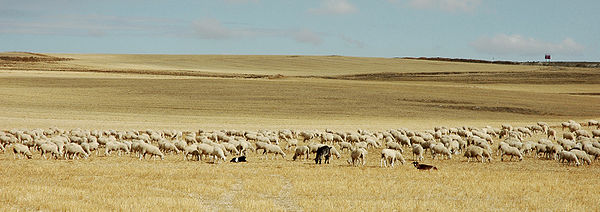 And our own civilization probably will leave a simila footprint: the towns and skyscrapers will become sparse heaps of rubbles, but the irreversibly collapsed ecosystem - for instance the desertified rainforests - will remain forever.
lunedì 4 marzo 2013
Lucio Dalla
Iscriviti a:
Post (Atom)