Visualizzazione post con etichetta ecological footprint. Mostra tutti i post
Visualizzazione post con etichetta ecological footprint. Mostra tutti i post
venerdì 28 ottobre 2016
When begins the Anthropocene?
The Anthropecene is the geological pewriod when the impact of human becomes desproportionately high. It has been proposed to characterize the present period, with widespread alteration ofg the environment, climate change, imission of radionucldies in the atmosphere. Although the idea begins to be generally accepted, the main problem is when? If the anthropocen has to be an actual geological period and not only a loose word, it must defined precisely in the same way as, for instance, the Pleistocene or the Cretaceous. In an unusually long paper on nature the author discusses three ideas: the discovery of the Americas, with borad floristic and faunal exchange among the continents, the onset of the industrial revolution or the beginning of atomic testing with rise of redionuclides in the atmosphere. Now a report f5rom WWE suggests another idea: the Anthropiocen has not yet begun. In the next few year, according to recent data, most vertebrates will vanish, with mass extinction anlagous to that marking the Permian-Triassic border or the Cretaceous-Paleocene. Is 2020 the date of the actual beginning of the Anthropocene?

giovedì 7 marzo 2013
Fecerunt desertum
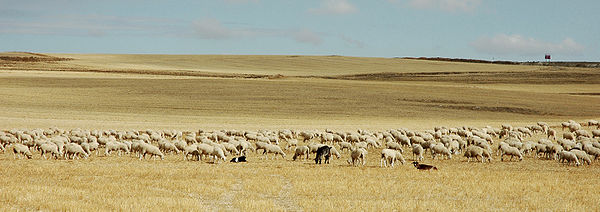
If you travel inner Sicily or Spain you will find a barren landscape, with sparse or no trees and extensive grasslands. This is ovioulsy related to low rainfall, but this landscape is by no means a natural one; it was originated by overexploitation of the soils for crop harvesting at the time of the Romans. The impoverished soils became unproductive, and were ledt abandoned or destinated to sheep grazing. This is perhaps the most striking heritage of the Roma Empire, much more, possibly, than the imposing ruins of temples and theaters.
 And our own civilization probably will leave a simila footprint: the towns and skyscrapers will become sparse heaps of rubbles, but the irreversibly collapsed ecosystem - for instance the desertified rainforests - will remain forever.
mercoledì 20 febbraio 2013
Industria
Sono venuto a sapere che l'Italia ha raggiunto gli obiettivi di Kyoto di una sensibile riduzione delle emissioni di gas serra. Potrebbe essere una buona notizia, ma ha un risvolto preoccupante: non è stato raggiunto con l'efficienza energetica e le energie alternative, ma principalmente perché, tra crisi e delocalizzazioni, negli ultimi venti anni praticamente abbiamo perso la nostra economia. Vedi cosa succede a mettere in mano il Paese a un industriale?
domenica 30 gennaio 2011
Happy decrease

The therocians of happy decrease gain every day more approval. They correctly address the problem that resources are not infinite, and that it is necessary to begin to reason about the decrease of the richness of the world. The ideas of these people meet those of the environmentalist, in particular the old idea sponsored in particular by WWF, that GIP doens't consider environmental assets and that it is necessaty to consider in economical polithisc also the ecological footprint.
The fact that we are consuming more resources than are available in the world and that growth cannot increase indefenitely are self-evident, and most countries in the world (not Italy) are considering seriously these problems. Nonetheless, I think that this line of reasoning is incomplete.
1) Rent is distributed very unequally among people, in particular in countries such as USA, UK and Italy (much less so in Germany. Sweden and other social-democratic countries). In the United States, 10% of the population own (and consume) about 90% of the national wealth. This means that should the remaining 90% of the people halve their income, the GIP and therefore the consumption of resources would decrease globally only by 5%. To my knowledge this arithmetical fact has not been even considered. It means that reducing inequalities of income - a traditional aim of the socialists - can reduce the consumption of resources without touching anyway the standard of living of people and even increasing the average income per person.
2) The supporters of the footprint have understood the fundamental yet rarely appreciated that GBP measures income and not assets; boradly speaking, GBP depend on the increase of assets, and not on asset in itself. Referring to the well known logistic curve, GBP is proportional to the tangent to the curve, whereas any point of the curve is the asset in a give moment of time. Growth at the beginning is slow, in the middle part is rapid, at the carrying capacity it is slow again, but now the assets are enormously larger than at the beginning. The supporters of the idea of the happy decrease do not stress the fact that we can decrease the growth without decreasing the asset - we can be very rich without increasing our richness. Of course this means a complete rearrangement f the economic, since in free market economy profits - the engine of the economic system - depend fundamentally on the increase of assets and not on assets per se(this is the reason why GBP, although obviously faulty, is fundamental in economy).
Iscriviti a:
Post (Atom)